

CASTANETUM


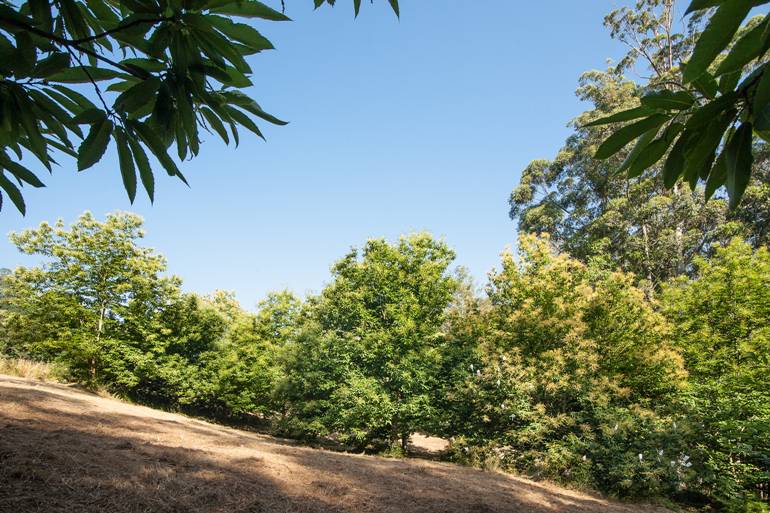
The Lourizán Forest Research Center (LFRC) boasts an extensive collection of chestnut materials from a highly diverse origin. One can find stands of Japanese chestnut (Castanea crenata) and Chinese chestnut (Castanea mollissima), as well as clonal banks of interspecific hybrids, primarily C. crenata × C. sativa. These materials were introduced during various periods from the establishment of the LFCR to the present, while different research lines were initiated.
In the late 1940s, three stands of Japanese chestnut (C. crenata) were planted (stand i : access road to the property, up on the right; stand ii : above the stone table; stand iii: on the track, climbing up Agrovello) and one stand of Chinese chestnut (C. mollissima), located between the track to Agrovello and the Agrovello stream, which flows down to the Rías Park. These stands were originated from populations in the Basque Country planted between 1917 and 1940. The stands are constituted by individuals of the pure species, with some exceptions, such as some hybrids resulting from natural cross-pollination of Japanese chestnuts by European chestnut, probably in the Basque Country stands from where the original seeds came. The Japanese and Chinese chestnut species were introduced because they are tolerant or resistant to ink disease caused by Phytophthora cinnamomi Rands, an oomycete fungus mainly found in areas of mild temperature and high humidity like the Galician coast. These exotic species were used by researchers Cruz-Gallástegui in the 1920s and 1930s, by Urquijo Landaluce in the 1950s, and Viéitez in the 1960s to create hybrids between European chestnut species and Asian species. Most of these hybrids exhibit tolerance or resistance to these diseases.
The so-called “Fila” Molina, planted around 1948, originally consisted of 16 trees. The first twelve are four series of half-siblings each: the first plant is C. sativa; the second, an interspecific hybrid; the third is a C. crenata. It is useful to appreciate the differences in vigor and conformation of the two parental species, C. sativa and C. crenata, and the high vigor of the hybrids between them.
The collection of hybrid chestnut planted in March 1979 by Gabriel Toval, director of the Lourizán Forest Research Center, includes a total of 72 different clones with a varying number of replicas. It is located next to the plantation of Castanea mollissima. This plantation, which initially contained 337 trees, includes a small part of the hybrids that were created by researchers Cruz-Gallástegui, Urquijo Landaluce, and Viéitez and shows a good performance in growth.